Breaking Stability
Analysis of fiber strain based on pulling test
Extrapolation until the limit of elasticity
The determination of the breaking stability evaluates the strength of the stem based on the results of the pulling test and compares it to the expected wind load.
Statistical evaluation of the measured data
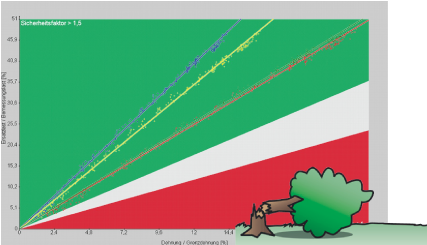
With a pulling test the fiber strain is measured under well-defined loads. Arbostat determines the best linear correlation from the force-strain values evaluating the quality of the measured results by means of statistic parameters. Deviations from the expected deformation will be analyzed and interpreted with regard to the state of the wood body.
Prognosis of deformation with pulling test
According to Hooke’s law, ArboStat extrapolates the measured strain up to the yield point of the green wood. For this purpose, several catalogs containing reference values specific to different tree species are available. This limit is defined as the point at which the deformation is no longer elastically reversible, causing the fibers to be permanently deformed and thereby damaged.
Measuring results and evaluation at one glance
The measured force-strain values and the resulting line of best fit are displayed in a graph. Since this line represents the behavior of the outer fibers under load, the failure load can be derived from it. Thus, the trajectory of the line illustrates the safety margins against breakage.