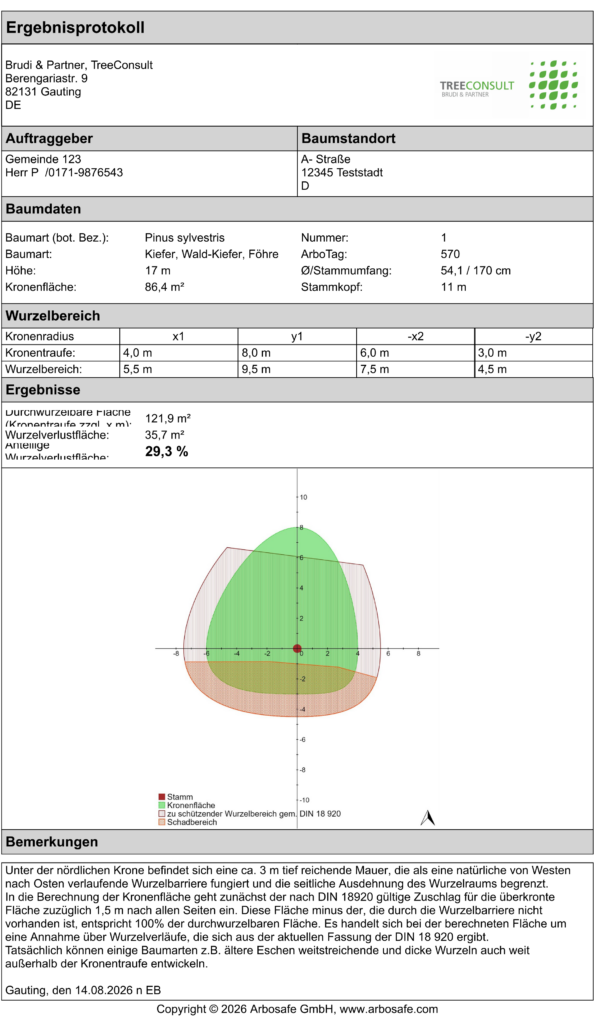
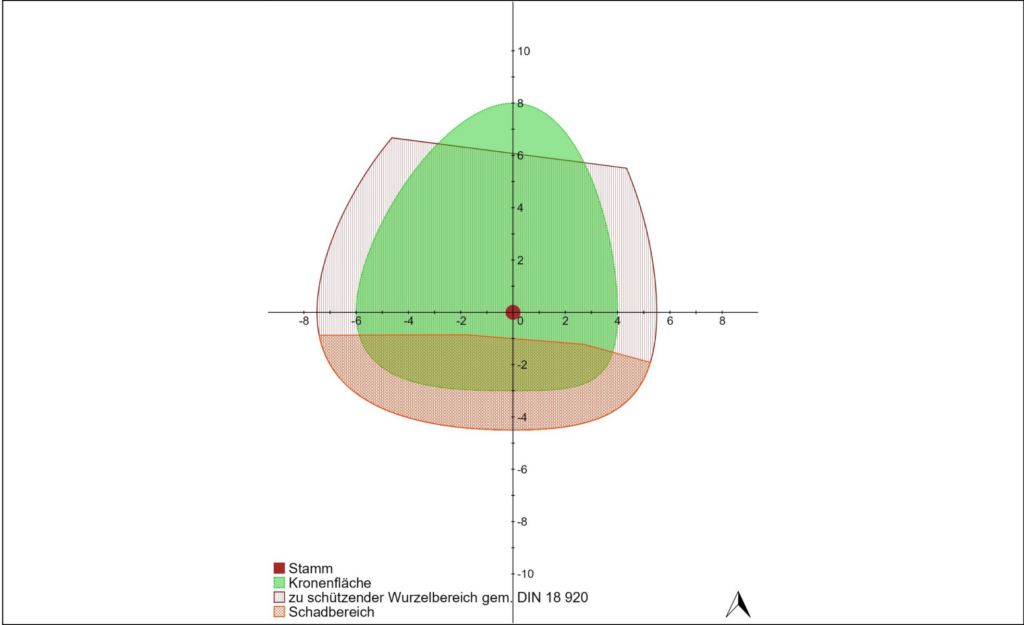
When intervening in the root zone, RootCalc can be used to calculate the area of the affected root zone. Natural obstacles in the soil (e.g., foundations) may restrict root growth. RootCalc detects these growth limitations and incorporates them into the area calculation. A straight or polygonal excavation boundary can then be drawn, and the root loss area is calculated with a single click.
Accurately determining the size of the root loss area supports the assessment of potential damage, the mitigation of damage shortly after it occurs, or the estimation of the tree’s economic value loss.
RootCalc is designed for arborists, municipal staff, landscape gardeners, and tree care professionals.
Individual root area
The root zone of trees extends, depending on the tree species and site conditions, beyond the canopy dripline. According to DIN 18920, a root zone is assumed to extend 5 meters beyond the canopy dripline on all sides for narrow-crowned trees, and 1.5 meters for all other trees. This value can be individually adjusted in RootCalc .
Drawing root barriers
Masonry remains, foundations, and structural components can act as natural root barriers in the soil.
They can be precisely marked in a grid using the point capture function. Any additional intervention, such as excavation work, may disproportionately increase the damage and contribute to the premature death of a tree. Drawing asymmetrical excavation boundaries in a grid simplifies data entry.
Personalized report printing
The result, showing the root loss area in sqm or %, is displayed in a report viewer and can be printed together with the personalized data. The report can also include your own logo, and the color scheme of each layer can be adjusted.