Windloads
Models from Eurocode 1 and DIN 1055-4
Vibration dynamics of trees exposed to wind
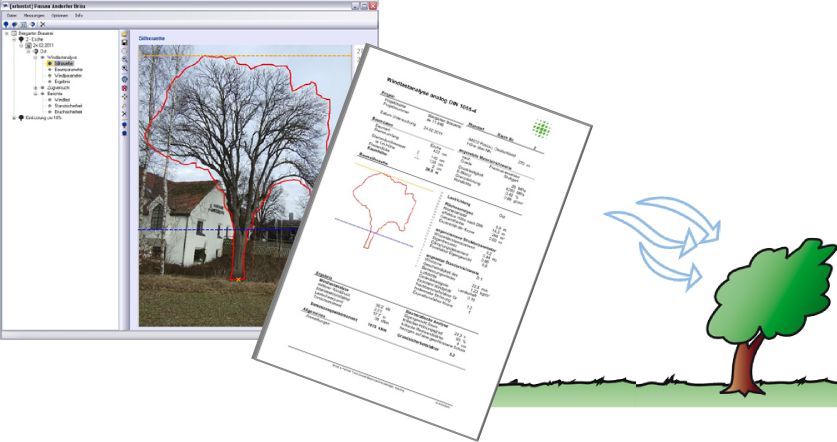
The impact of wind on trees is determined by various factors. Although they cannot be predicted exactly, load estimations are indispensable for safety considerations. Arbostat provides a comprehensible option for the estimation of expected wind loads.
Wind parameters based on standards
Arbostat follows the calculative approaches of the Eurocode 1. The impact of urban development and topography on the wind structure is estimated by means of terrain categories based on national standards for aerodynamic engineering. Moreover, adjustments are made to small-scale airflow conditions, e.g. due to neighboring buildings or groves.
Evaluation of the dynamic behavior
Structures prone to oscillation react dynamically in turbulent wind flows. While resonance can lead to amplified swaying and an increased risk of failure, peak loads can be buffered or reduced by damping effects caused by the movement of a tree's branch structure. These phenomena in trees have been scientifically investigated in recent years. The dynamic behavior of trees is integrated into the calculations of the ArboStat and TreeCalc software.
Equivalent static wind load
ArboStat ArboStat does provide current scientific results in order to evaluate the dynamic properties of trees. Following the regulation DIN 1055-4 an equivalent static substitute load is determined which causes the same amplitude like a gusty storm. This way, the results of tree static measuring techniques, e. g. pulling tests, can be compared to the impact of wind dynamics